
We may earn a commission if you buy through links on this page. It never changes a score or a ranking. How we make money
The bottom line
Regal offers broad AI customer-service tools, but custom quotes leave small-team costs uncertain.
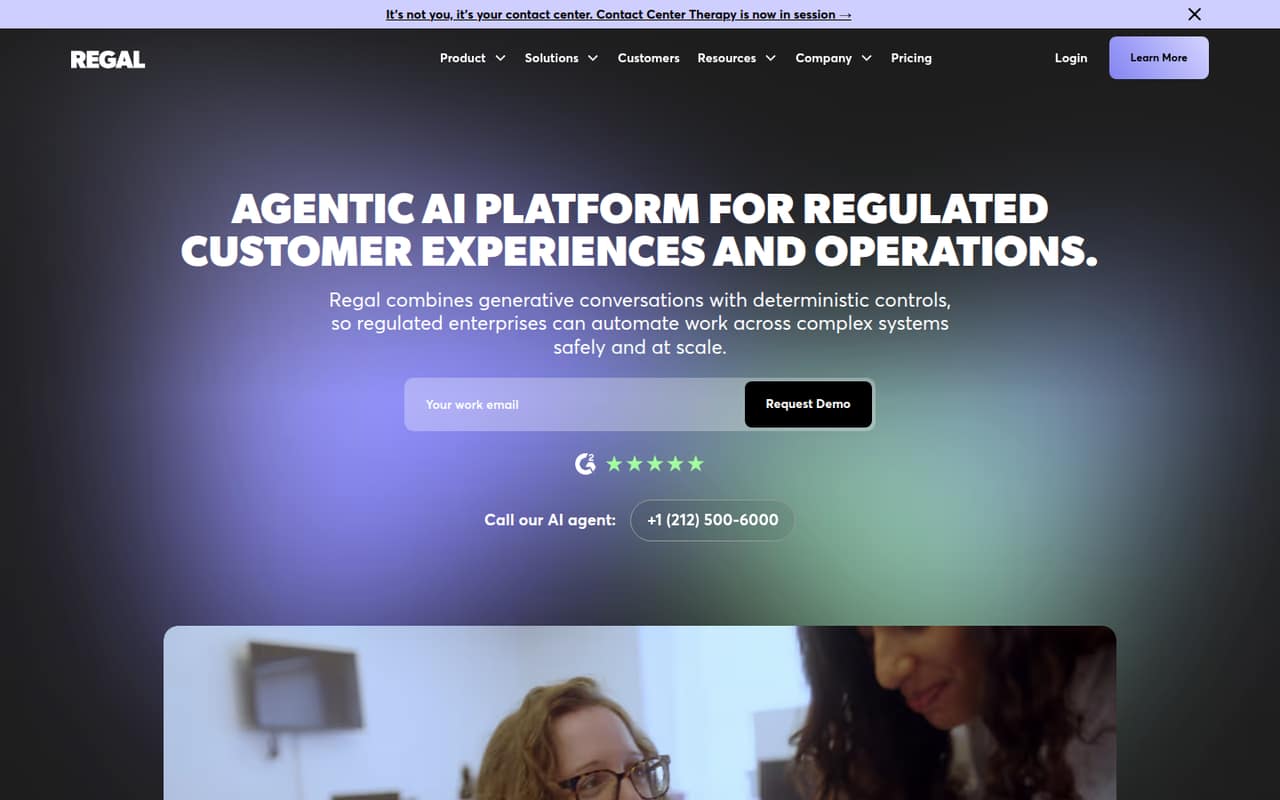
Regal combines AI agents for phone, SMS, chat and WebRTC voice with tools for orchestration, customer profiles, A/B testing and conversation intelligence. Its focus is regulated customer experiences and complex operations, not a simple starter phone bot.
For a small team watching its budget, the main obstacle is the buying model: Regal has no free plan, and its pricing page lists custom quotes rather than rates. Ask for a quote and a clear estimate for your team size before committing.
Good fit if
- Regulated customer-service operations
- Contact centers with complex workflows
- Teams coordinating agents and automation
Skip it if
- Teams needing a free starting plan
- Buyers who need published seat prices
- Small teams seeking simple phone automation
ScoresHow it rates
What works
- Agents support phone, SMS, chat and WebRTC voice
- Coordinates AI agents, human teams and automation
- Customer profiles can personalize conversations
- Includes native A/B testing
- Conversation intelligence supports monitoring and automated QA
What doesn't
- No free plan
- No published starting price
- Pricing is custom-quoted
- Small-team per-seat costs are unavailable
- Setup steps and integration details need confirmation
01Who Regal is for
Regal is aimed at regulated businesses that manage customer interactions through contact centers and complex workflows. Its AI agents handle conversations across phone, SMS, chat and WebRTC voice, while orchestration tools coordinate AI agents, human teams and automation. Customer profiles can personalize interactions, and conversation intelligence can help monitor calls and automate quality assurance.
For a team of one to ten, the fit depends less on headcount than on the work: Regal makes more sense when customer conversations need controls and coordination across enterprise systems. It is a harder fit for a small business that just wants a basic calling tool or a predictable monthly bill. The pricing page lists custom quotes, with a fit proxy of at least 25 agents and 100,000 call minutes per month. That points toward larger contact-center deployments. A smaller team should ask Regal whether it will quote its volume and what minimum commitment applies.
02Regal free plan and trial
Regal does not offer a free plan, according to its pricing information. Trial availability is not published, so ask the vendor whether your team can evaluate the platform before signing and what that evaluation includes. Do not plan on testing it with an ongoing free tier.
The cheapest way in is a custom quote; Regal does not publish a starting price or a self-serve plan. The pricing information describes a fit proxy of at least 25 agents and 100,000 call minutes per month, which is a much larger operation than a typical one-to-ten-person team. If you are below that size, ask whether Regal accepts smaller deployments and whether the quoted minimum includes implementation, usage or contract commitments. Get those details in writing before comparing the quote with a per-seat tool.
03What a small team pays for Regal
Regal's pricing page lists custom quotes, not a monthly or annual rate. There is no published starting price, per-seat price or billing rate to use for a reliable one-person, three-person or five-person calculation. So the honest cost for one seat, three seats and five seats is unknown—not zero, and not a figure we can estimate from the available pricing terms.
The listed fit proxy is at least 25 agents and 100,000 call minutes per month. Regal notes discounts for longer contract terms and higher committed spend, but it does not publish the discount amounts. No add-on prices are listed. That leaves a small buyer without a public way to calculate whether a limited deployment is affordable or whether usage adds to the bill.
Ask Regal for a written quote at your actual agent count and call volume. Confirm minimum seats or minutes, contract length, included features, any usage charges and what happens if you scale down. Until then, there is no meaningful monthly-versus-annual comparison for a small team.
04Getting started with Regal
Regal's setup effort and learning curve are not something a small team should guess at from a feature list. The platform is designed to coordinate AI agents, human teams and automation across enterprise systems, so plan to discuss workflow configuration and the systems your agents must work with before signing. That is a practical expectation, not a published implementation timeline.
The product description names enterprise-system connections as part of Regal's work, but does not specify supported integrations or a day-one setup checklist. Ask which systems are supported for your use case, what your team must configure, and whether Regal provides implementation help. Also clarify who will set conversation rules, customer-profile data and quality checks. Those details will determine whether a small team can manage setup itself or needs vendor assistance. We would not budget a launch date until Regal confirms the scope and responsibilities in writing.
05When small teams outgrow Regal
Regal's published fit proxy already points to a large contact center: at least 25 agents and 100,000 call minutes per month. A small team may therefore find that the buying model is a mismatch before it outgrows the product. Custom quotes, unpublished minimums and no public seat rates make it hard to forecast costs as headcount or call volume changes.
If your operation grows, the platform's phone, messaging, orchestration and conversation-intelligence features may suit more complex work. But ask how pricing changes with more agents, minutes and committed spend, and whether longer terms are required for discounts. The pricing information does not publish tiers, overage rates or upgrade thresholds, so there is no public point at which a team must move plans. If Regal cannot quote your current size or explain the cost of scaling, compare it with tools that publish rates and let you budget seat by seat.
Questions people ask
Does Regal have a free plan?
No. Regal's pricing information says there is no free plan. Trial availability is not published, so ask the vendor whether it offers a trial or guided evaluation, how long it lasts and which features are included before making a purchase decision.
How much does Regal cost?
Regal uses custom quotes, and its pricing information does not publish monthly or annual rates. It also does not list a starting price or per-seat cost. Ask for a quote based on your agent count, call volume, contract term and any usage charges.
Is Regal suitable for a small team?
It may fit a small team with regulated customer interactions and complex workflows, but the pricing model is oriented toward larger contact centers. The listed fit proxy is at least 25 agents and 100,000 call minutes per month. Ask whether Regal will quote your actual scale.
Which channels does Regal support?
Regal's product description lists phone, SMS, chat and WebRTC voice agents. It also describes agent orchestration, customer profiles, A/B testing and conversation intelligence. Confirm with Regal which channels and capabilities are included in the quote for your deployment.
Does Regal publish setup requirements or integrations?
Supported integrations and a day-one setup checklist are not specified in the product details. Before buying, ask Regal which enterprise systems it supports for your workflows, what configuration your team must handle and whether implementation assistance is included in the quote.