
We may earn a commission if you buy through links on this page. It never changes a score or a ranking. How we make money
The bottom line
Useful food-market intelligence, but custom pricing makes the small-team budget hard to judge.
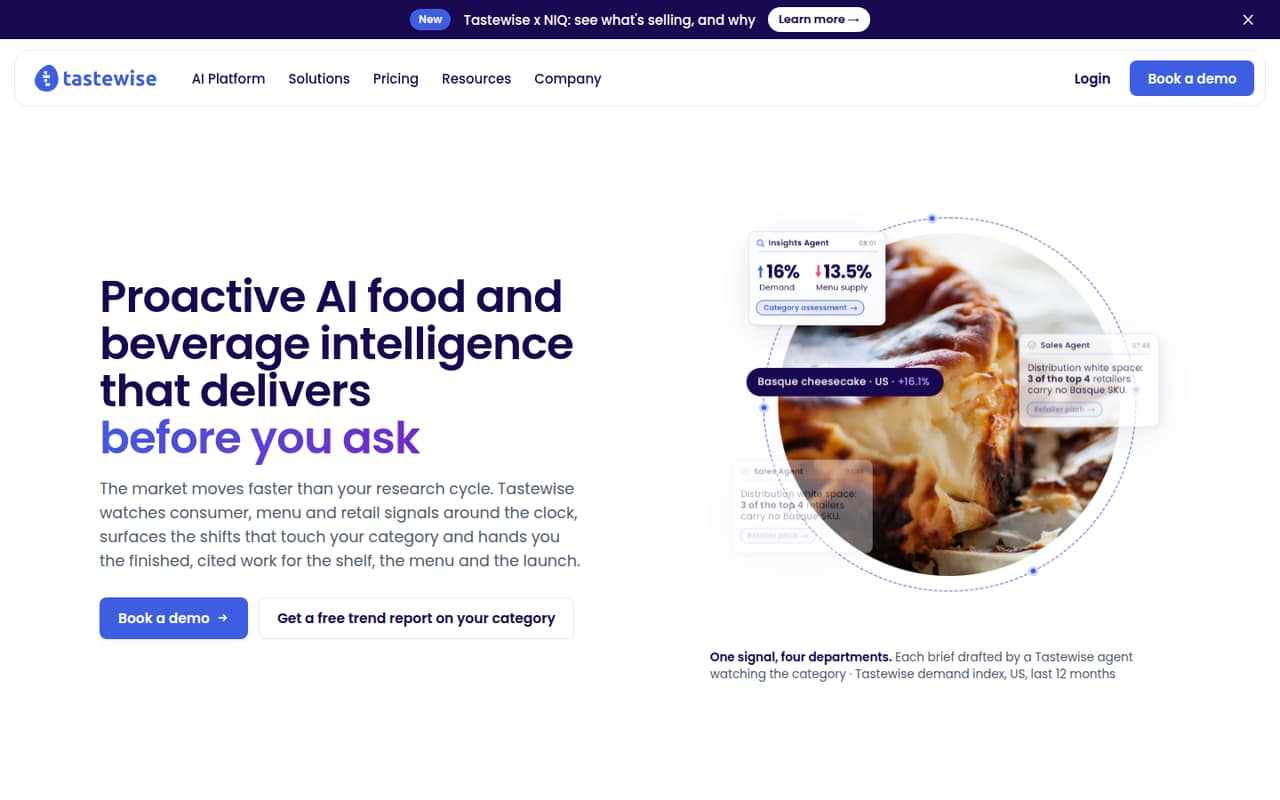
Tastewise brings consumer, retail, restaurant-menu, and company data together for food and beverage research. Its AI agents monitor categories, accounts, and competitors, while its tools can create briefs, concept decks, and retailer stories.
The catch for a small team is cost clarity: the pricing page lists custom plans, with no published starting price, free plan, or trial. Ask for a quote that spells out seats, usage, market coverage, and brief limits before budgeting.
Good fit if
- Food and beverage research teams
- Brands tracking multiple markets
- Teams producing retailer or concept briefs
Skip it if
- Teams needing a free research tool
- Buyers requiring predictable per-seat pricing
- Companies outside food and beverage
ScoresHow it rates
What works
- Combines consumer, retail, menu, and company data
- AI agents monitor categories, accounts, and competitors
- Food ontology connects entities across sources
- Creates concept decks and marketing briefs
- Figures include source, sample, and date details
What doesn't
- No free plan or free trial listed
- Starting price is not published
- Seat and usage limits are not published
- Pricing varies by modules, markets, and brief volume
- Monthly and annual billing terms are not published
01Who Tastewise is for
Tastewise is aimed at food and beverage teams that need to understand demand across consumer, retail, restaurant-menu, and company data. It is most relevant to people in marketing, sales, innovation, and research who need to track category shifts, competitors, or accounts and turn findings into work others can use.
For a small team of roughly 1–10 people, the fit depends less on headcount than on whether market intelligence is a regular job. A team making retailer pitches, evaluating product concepts, or monitoring several markets may get more from a connected dataset and prepared deliverables than a team doing occasional research. The pricing page lists custom pricing based on modules, market coverage, and brief volume, so there is no published budget threshold. We would treat it as a specialist business tool, not a low-cost general-purpose analytics subscription, and request a quote before adding it to a small-team budget.
02Tastewise free plan and trial
The pricing information lists no free plan and no free trial. That means a small team should not plan on using a permanent free tier to explore the platform or start with a no-cost pilot. The vendor does not publish a self-serve entry plan or trial terms.
The cheapest way in is a custom or tailored plan: the pricing page says cost scales by selected modules, market coverage, and brief volume. It does not publish a starting price, seat limits, or usage limits, so we cannot estimate even a one-person subscription. Before agreeing to a sales conversation, ask whether the vendor can quote a narrow package for one market, a small number of users, and a limited volume of briefs. Also ask whether any evaluation access is available; trial availability is not listed.
03What a small team pays for Tastewise
Tastewise does not publish a starting price, a per-seat rate, or monthly and annual billing terms. The pricing page lists custom pricing that scales by selected modules, market coverage, and brief volume. As a result, the cost for one person is not published, and neither is the cost for three or five people. Per-seat maths and monthly-versus-annual comparisons are not possible from the listed prices.
The page also says seat and usage limits are not published. Ask for a written quote showing the total for your actual team size, whether additional seats change the price, what brief volume is included, and how adding markets or modules affects the bill. No add-ons are listed, but that does not answer what is included in each custom package. The Enterprise plan is described for large CPGs and global teams, with multi-brand portfolios, multi-market coverage, modular integration options, and enablement options; its price is also not published. For a small team, get a tailored quote rather than assuming Enterprise is the entry point.
04Getting started with Tastewise
The vendor does not publish setup steps, implementation timelines, or a detailed learning curve in the pricing information. Tastewise describes its data as spanning consumer, retail, away-from-home, and company sources, with food-trained models connecting products across those sources. That makes it worth clarifying how the platform will be configured for your categories and markets before you commit.
The product description says AI agents can monitor categories, accounts, and competitors, and that runs are logged with figures carrying source, sample, and date information. The pricing page lists modular integration options for Enterprise, but does not name integrations or say which plans include them. For a 1–10 person team, ask what setup work your team must do, which data sources and integrations are included in your quote, and whether onboarding or enablement is included. We cannot verify those details from the vendor’s published information.
05When small teams outgrow Tastewise
Tastewise’s pricing structure can become harder to manage as a team adds markets, modules, or more briefs: the pricing page says those factors affect cost, but does not publish rates or usage thresholds. Ask the vendor how each expansion changes the quote before building the platform into a wider workflow. Seat limits are also not published, so growing from a few users to a larger group calls for a fresh written estimate.
A different tool may make more sense if your team mainly needs general business intelligence rather than food-specific consumer, retail, and menu signals. Tastewise’s described strengths center on food data, food ontology, monitoring agents, and team deliverables; the pricing material does not establish whether it covers broader analytics needs. For large CPGs or global teams, the vendor positions Enterprise for multi-brand portfolios and multi-market coverage, with modular integration and enablement options. Confirm the cost and limits at each stage instead of assuming a specific upgrade threshold.
Questions people ask
Does Tastewise have a free plan?
The pricing information lists no free plan. It also lists no free trial, so a team should not assume it can evaluate the platform at no cost. Ask the vendor whether evaluation access is available and what conditions apply before planning a pilot.
How much does Tastewise cost for a small team?
Tastewise does not publish a starting price or per-seat rate. Its custom pricing scales by modules, market coverage, and brief volume, while seat and usage limits are not published. Request a quote for your team size and expected use before comparing it with a fixed-price tool.
What does Tastewise do?
Tastewise combines consumer, retail, restaurant-menu, and company data for food and beverage teams. Its AI agents monitor categories, accounts, and competitors, and the platform can surface trends and produce work such as concept decks, retailer stories, and marketing briefs.
Who is Tastewise best suited for?
It is designed for food and beverage teams working in areas such as marketing, sales, innovation, and research. It may fit teams that regularly track category demand, competitors, accounts, or opportunities across markets and need to turn those signals into shared deliverables.
Does Tastewise include integrations and onboarding?
The pricing page lists modular integration options and enablement options for Enterprise, but does not name integrations or describe onboarding for every plan. Ask which integrations, setup help, and enablement are included in the specific package you are quoted.