
We may earn a commission if you buy through links on this page. It never changes a score or a ranking. How we make money
The bottom line
Consider Uniphore for governed enterprise AI; get a quote before budgeting for a small team.
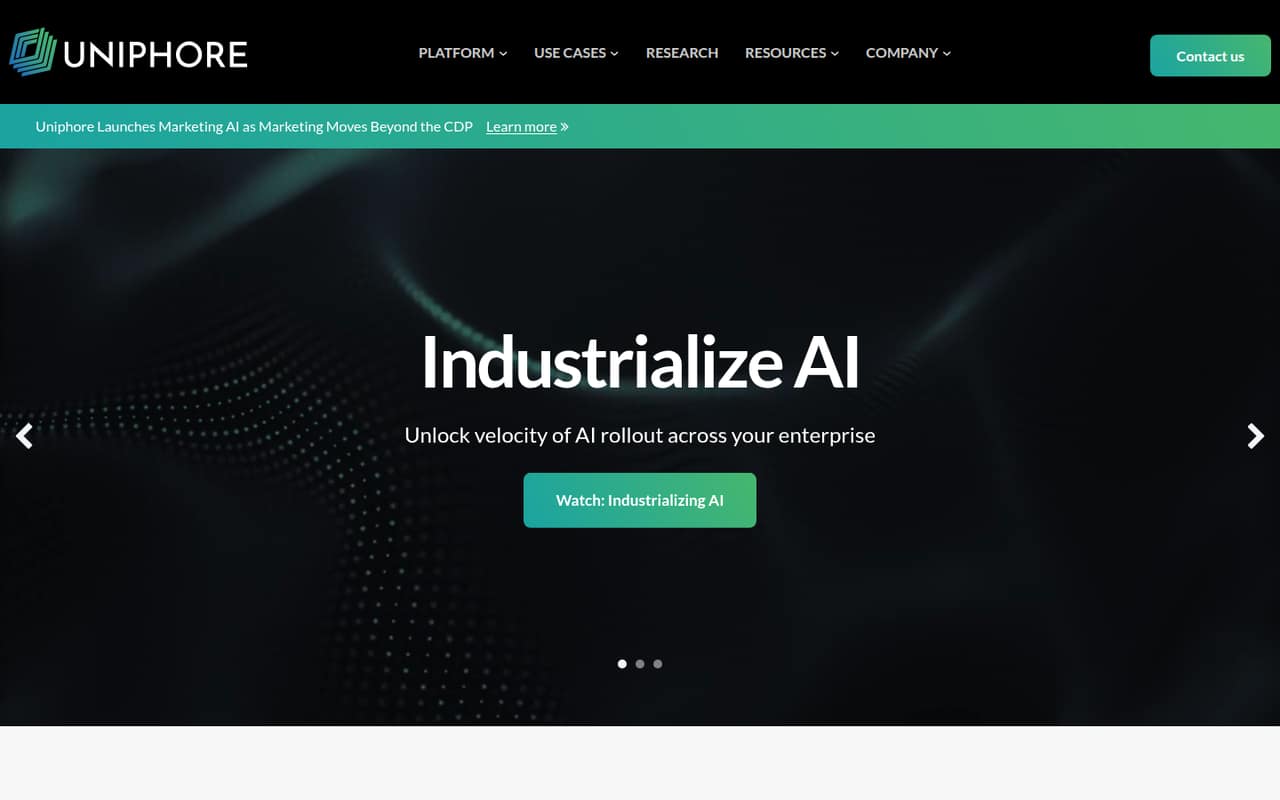
Uniphore describes an enterprise platform for connecting fragmented data, building domain-specific intelligence, and deploying AI agents in business workflows. Its listed capabilities include multi-agent orchestration, governance, small language models, data transformation, and inference optimization.
For a team of 1–10, the main obstacle is buying clarity: pricing is custom-quoted, seat and usage limits aren't published, and there is no listed free plan. Ask sales for a written quote and the minimum commitment before evaluating fit.
Good fit if
- Enterprises building governed AI agents
- Teams connecting fragmented business data
- Organizations needing workflow orchestration
Skip it if
- Small teams needing a free tier
- Buyers requiring predictable seat costs
- Teams wanting published self-serve limits
ScoresHow it rates
What works
- Coordinates multiple agents with deterministic execution
- Lists security, governance, and model controls
- Uses domain-specific small language models
- Targets data transformation across fragmented systems
- Includes inference optimization and agentic workflows
What doesn't
- Pricing is custom-quoted
- Seat and usage limits aren't published
- Plan inclusions aren't published
- No free plan is listed
- Trial terms aren't published
01Who Uniphore is for
Uniphore is aimed at enterprises that want to connect scattered business data and deploy AI agents across workflows, with controls for data, models, and execution. In plain terms, it is an orchestration layer for building and governing business-specific AI, not a lightweight chatbot subscription.
A team of 1–10 could consider it if AI agents are central to its operations and it has a budget for a custom enterprise engagement. But the vendor doesn't publish a minimum seat count, a starting price, or a self-serve route, so a small team can't tell from the pricing listing whether it qualifies or what it will spend. We would ask for a quote that spells out users, usage limits, implementation scope, and the workflows covered. If the need is a low-cost tool for a few seats, Uniphore looks like a difficult fit to assess.
02Uniphore free plan and trial
The pricing listing shows no free plan. It does not publish free-trial terms, so a small team should ask Uniphore directly whether it offers a time-limited evaluation, what access that includes, and whether setup or usage fees apply.
The cheapest listed way in is the Custom plan, sold through a custom quote. That is not a usable entry price: the listing gives no monthly or annual rate, seat minimum, usage allowance, or plan inclusions. For a team watching every subscription, get written answers before scheduling an evaluation. In particular, confirm whether a trial is available, how long it lasts, which AI orchestration features it covers, and whether any work is needed to connect your data. Without those details, there is no public free option to use as a low-risk starting point.
03What a small team pays for Uniphore
The pricing listing names one plan, Custom, for enterprises seeking AI orchestration. It is sold by custom quote, and the starting price is not published. That means we can't calculate a reliable cost for one person, three people, or five people: there is no per-seat price to multiply. Monthly and annual billing terms also aren't published.
Seat and usage limits, plan inclusions, and add-ons aren't published either. The pricing listing shows no add-ons, but that doesn't establish whether optional services are available; ask sales for an itemized quote. For a small-team budget, request the total price for your exact seat count and expected usage, whether seats are billed individually, any minimum commitment, and what is included in implementation and support. Until Uniphore provides those figures, a meaningful monthly-versus-annual comparison—or a cost for a few seats—is not possible.
04Getting started with Uniphore
Uniphore describes its platform as connecting fragmented data, building domain-specific intelligence, and deploying governed AI agents. That points to work involving data and business workflows, rather than a simple account signup, but the vendor doesn't publish a setup timeline or implementation steps in the available product and pricing details. We can't responsibly estimate the effort in hours or days.
Integration names, supported connectors, and setup documentation aren't published in the available details either. Before choosing the tool, ask which of your data sources and business systems it supports, what your team must configure, and whether Uniphore handles any of that work. Also ask what technical roles you need on your side and what training is included. For a 1–10-person team, those answers matter as much as the feature list: a platform can fit the job but still require more implementation capacity than the team has.
05When small teams outgrow Uniphore
Uniphore's stated focus is enterprise AI orchestration, so the likely mismatch for a small team is not a published seat ceiling but the lack of public buying details. The vendor doesn't publish seat or usage limits, plan inclusions, or a starting price. That makes it hard to tell when a team would need a larger plan, pay more for usage, or add services as adoption grows.
Before committing, ask for written thresholds for seats, data volume, agent activity, and any usage-based charges, along with the price at each level. Also clarify whether the quote includes the workflows and governance controls you need as more teams adopt the platform. If Uniphore can't provide a clear growth schedule, budget owners may struggle to forecast the next renewal. A growing team should compare the quoted cost and limits with its requirements before treating the custom plan as a long-term fit.
Questions people ask
What does Uniphore do?
Uniphore describes itself as an enterprise data and AI orchestration platform. It is designed to connect fragmented data, build domain-specific intelligence, and deploy AI agents across business workflows, with controls for data, models, and workflows.
Is Uniphore a good fit for a small team?
It may fit a small team with a clear need for governed AI agents and the budget for a custom enterprise engagement. But the vendor doesn't publish a starting price, seat limits, or plan inclusions, so teams should get a detailed quote before deciding.
How much does Uniphore cost?
Uniphore lists a Custom plan sold through a custom quote. It doesn't publish a starting price or per-seat rate, and monthly and annual billing terms aren't published. Ask sales for the full cost for your team size and expected usage.
Does Uniphore offer a free plan or trial?
The pricing listing shows no free plan. Trial terms aren't published, so ask Uniphore whether an evaluation is available, what features and usage it includes, and whether any fees or commitments apply.
What should a buyer ask Uniphore before signing?
Ask for the total price, seat and usage limits, any minimum commitment, and how costs change as adoption grows. Confirm which integrations are supported, what implementation work is included, and whether a trial is available.